
Disease and target evidence
A versioned evidence model connects indication, mechanism, target, population, assays, literature, contradictions, and the decision rights of scientific reviewers.


Computational discovery organised around experimental evidence.
Quinno is a proposed computational drug-discovery pipeline connecting disease evidence, molecular structure, predictive modelling, physics-based simulation, experimental assays, and verifiable research lineage.
The programme gives priority to neglected, rare, and high-need disease areas, but it does not present a validated drug candidate, clinical outcome, production quantum workflow, or demonstrated quantum advantage. Classical baselines and wet-lab evidence remain the reference against which every computational method must be judged.
Target brief through assay feedback
Evidence, representation, computation, validation
Classical baseline and gated quantum study
Prospective evidence before performance claims
Discovery fails when uncertain biology, inconsistent data, optimistic models, and late experimental feedback are compressed into one confident ranking.
Drug discovery is a sequence of evidence gates. Target relevance, molecular interaction, selectivity, exposure, toxicity, manufacturability, and clinical translation are different questions, supported by different experiments. A candidate can score well in one model and still fail because the model did not represent the next constraint.
Quinno therefore treats computational ranking as a decision-support step inside an experimental loop. The objective is to make uncertainty visible, select the next informative test, preserve failed results, and prevent a promising score from being mistaken for biological proof.
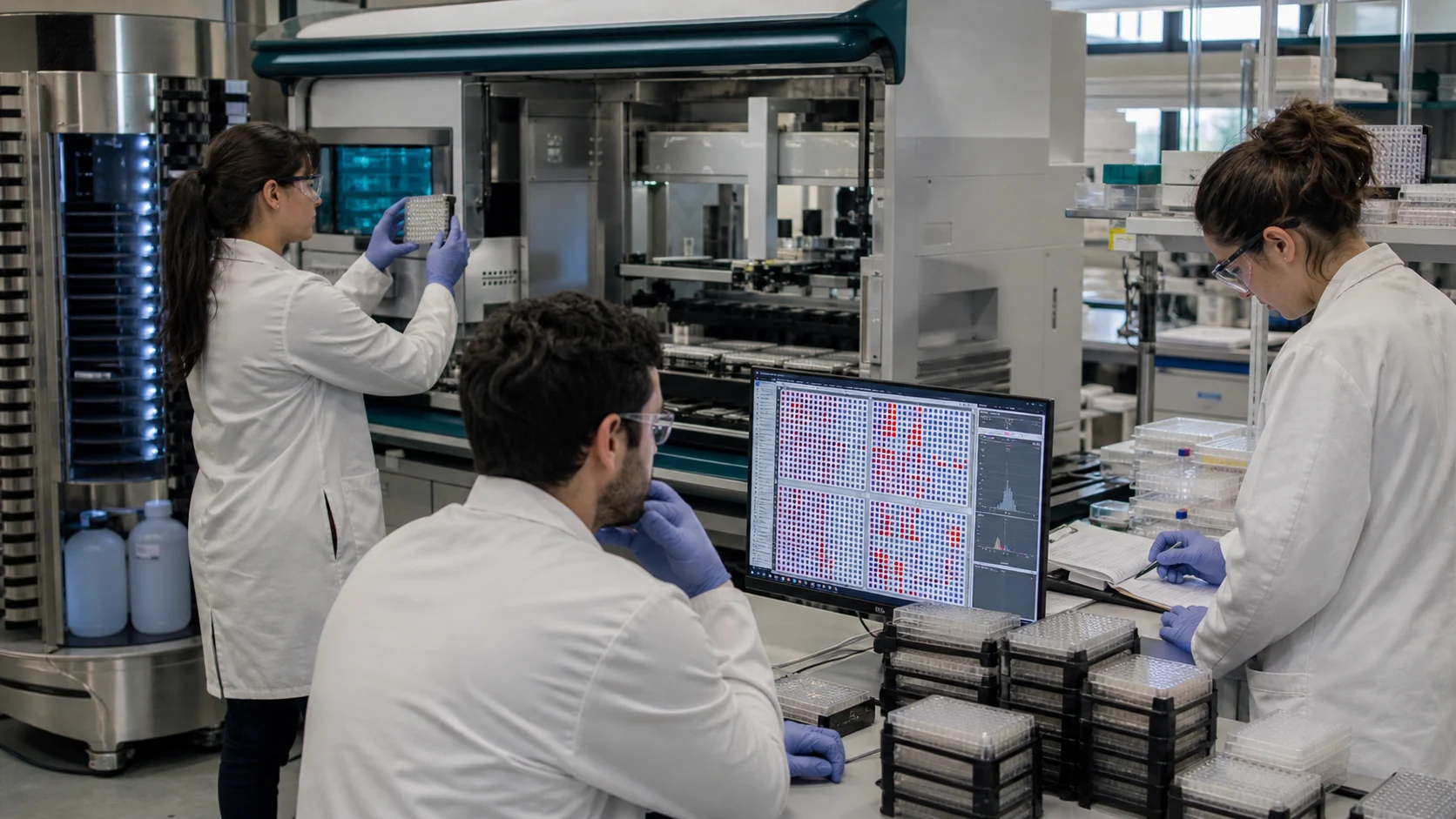
State the unmet need, biological hypothesis, target-product profile, known evidence, intended population, and the decision the programme must make next.
Assemble structures, sequences, assays, compounds, literature, provenance, negative results, and quality controls without collapsing incompatible measurements into one dataset.
Construct candidate molecules and representations that retain chemical validity, three-dimensional context, uncertainty, synthesis constraints, and the domain in which the model was trained.
Use predictive and physics-based methods to rank candidates while exposing calibration, applicability limits, competing objectives, and the classical baseline for each task.
Select an assay or bounded compute study that can distinguish hypotheses, including quantum experiments only where the instance, resources, and comparison method are declared in advance.
Record the outcome, failure mode, protocol, model version, and decision consequence, then update the evidence base without hiding negative or inconclusive results.
A versioned evidence model connects indication, mechanism, target, population, assays, literature, contradictions, and the decision rights of scientific reviewers.
Sequences, conformations, binding sites, molecular graphs, chemical features, and three-dimensional ensembles are retained with source, preparation, and uncertainty context.
Models support generation, ranking, property estimation, and experiment selection while reporting domain limits, calibration, baseline performance, and versioned training evidence.
Classical molecular methods remain the comparison path. Qontos-linked experiments are isolated, resource-accounted studies rather than a claim that production quantum chemistry is available today.
Dataset versions, code, parameters, model artefacts, assay protocols, approvals, outputs, and decisions form a replayable record with appropriate controls for sensitive research data.
A rigorous validation record should show where a method works, where it fails, whether it changes an experimental decision, and whether another team can reproduce the result.
Separate compounds, scaffolds, targets, time periods, and assay families appropriately; document exclusions, missing data, duplicates, and sources of label uncertainty.
Report task-appropriate error, rank correlation, enrichment, precision, calibration, and uncertainty alongside simple and established scientific baselines.
Freeze the model and selection rule before testing new candidates, then disclose the full tested set, controls, protocol, failures, and decision consequence.
Retain data versions, environments, parameters, seeds, resource use, code lineage, and assay linkage so an independent reviewer can reconstruct the result.
Computational and preclinical results must not be represented as safety, efficacy, regulatory approval, or patient benefit without the required experimental and clinical evidence.
Potential programmes should be chosen with disease-area partners, accessible assays, relevant biological models, and a realistic path from computational study to experimental decision.
Small populations increase the importance of mechanistic evidence, careful uncertainty, patient and clinician context, data governance, and collaboration with specialist research networks.
Candidate work requires pathogen-specific assays, resistance mechanisms, selectivity, exposure, stewardship context, and explicit treatment of the difference between in vitro activity and clinical utility.
Universities, biotechnology teams, product-development partnerships, and laboratories can bring a defined target, assay, compound set, or decision problem into a bounded validation programme.
Quinno is establishing a computational discovery workflow around declared disease hypotheses, governed datasets, reproducible classical baselines, and frozen candidate-selection rules. Therapeutic, clinical, and quantum-advantage claims require separate experimental evidence.
The next validation package is a prospective assay with appropriate controls, a complete result set including failures, and a documented decision about what advances or stops.