
Spectra display plane
The concept specifies a self-emissive MicroLED display intended to improve control of black level, luminance, colour, and viewing-angle consistency. Resolution and brightness remain design targets pending physical measurement.


Cinema engineered as one spatial system.
Sylvain is a proposed cinema systems architecture that treats display, audio, spatial depth, content mastering, and auditorium calibration as one engineered environment.
The current architecture establishes performance targets for an instrumented reference room. Prototype records, seat-by-seat measurements, installed venues, and commercial availability remain future validation gates.
Display, audio, intelligence, depth
Private, flagship, licensable, creator
One source package, format-specific output
Reference-room validation is the next gate
A cinema is purchased as equipment, but experienced as a distributed visual and acoustic field.
Seat position, viewing angle, room geometry, reflective surfaces, loudspeaker placement, and calibration can change what each viewer sees and hears. Consistent performance therefore requires measurement across the seating bowl, not only nominal equipment specifications.
Sylvain's central proposition is therefore a systems problem: the display, audio array, spatial layer, mastering metadata, and calibration process must be designed together and evaluated across the room.
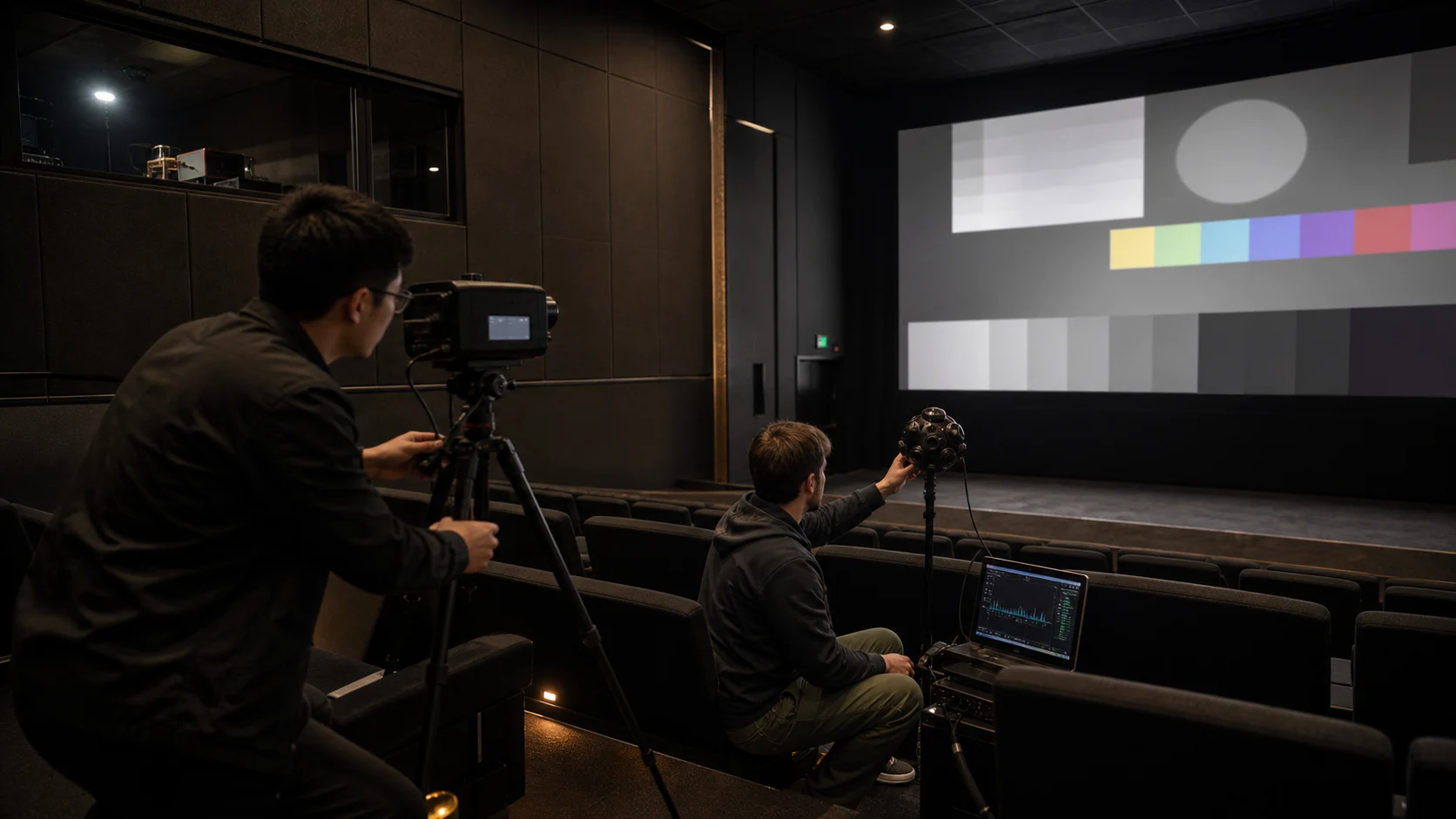
The concept specifies a self-emissive MicroLED display intended to improve control of black level, luminance, colour, and viewing-angle consistency. Resolution and brightness remain design targets pending physical measurement.
The proposed audio layer uses Wave Field Synthesis and a dense loudspeaker array to reconstruct wavefronts across the auditorium. Channel count, driver count, spatial accuracy, and latency remain targets that require physical validation.
The intelligence layer is designed to combine content metadata with room geometry and calibration measurements, then coordinate display, audio, depth, and haptics. Model evaluation and measured accuracy remain validation requirements.
The concept introduces transparent multi-plane compositing for selective glasses-free depth. Plane count, transparency, viewing envelope, visual comfort, and content suitability must be tested before performance claims can be made.
A small private-cinema format built around bespoke room design and controlled calibration. The 100-seat capacity remains a concept target pending a reference installation.
A large destination auditorium proposed around a curved display, Wave Field Synthesis, and high-density seating. The stated capacity and performance specifications are unvalidated design targets.
A retrofit-oriented package for premium commercial cinemas. Physical installation, interoperability, operational performance, and commercial validation remain ahead.
A mastering toolchain for display, audio objects, depth, and haptics, with format-specific outputs derived from one source package. Software availability and interoperability remain validation requirements.
Declare the image, sound, depth, haptic, and timing metadata used for every test so results can be replayed after each system change.
Map geometry, screen output, ambient conditions, acoustic impulse response, noise floor, loudspeaker position, and representative seat coordinates.
Apply bounded display, audio, timing, and spatial corrections while preserving the declared creative master and recording every adjustment.
Measure visual uniformity, localisation, level, latency, synchronisation, depth visibility, and comfort across a declared seat map and content set.
Report the passing range, outliers, drift, failures, comparator system, instruments, uncertainty, and conditions under which the result can be reproduced.
Measure luminance, black level, colour error, angular variation, temporal stability, motion behaviour, and pixel or module failures against a declared master.
Measure localisation error, frequency response, sound-pressure variation, impulse response, latency, distortion, and performance across representative seats.
Measure depth visibility, occlusion, angular envelope, brightness interaction, artefacts, fatigue, and accessibility across content types and viewing durations.
Measure audiovisual synchronisation, calibration drift, failover, thermal behaviour, mastering fidelity, configuration lineage, and repeatability between sessions.
Sylvain defines a technical architecture, four named subsystems, and four delivery formats. The programme now advances toward an installed reference system with reproducible measurement methods.
The next validation milestone is an instrumented reference room with a frozen content package, declared comparator, seat map, acceptance criteria, complete results including failures, and a documented decision about which elements advance.